



Why has PTFE become a core material for industrial corrosion protection and sealing?
From Pure PTFE to Modified PTFE: How Do Glass Fiber, Graphite, Copper Powder, and Ceramic Powder Enhance Material Properties
Jiangxi Zhaohui Fluoroplastic Products Co., Ltd. specializes in the R&D and manufacturing of PTFE and modified PTFE products. Due to its exceptional corrosion resistance, low coefficient of friction, stability across a wide temperature range, and electrical insulation properties, PTFE is widely used in critical components across sectors such as the chemical industry, machinery, sealing, anti-corrosion, electronics, and aerospace.
However, pure PTFE has certain limitations, such as limited wear resistance, insufficient creep resistance, and low thermal conductivity. To meet the demands of more complex operating conditions, the industry typically employs filler modification techniques—incorporating materials like glass fiber, graphite, copper powder, or ceramic powder into the PTFE matrix—to enhance its overall performance.
I. What is PTFE?
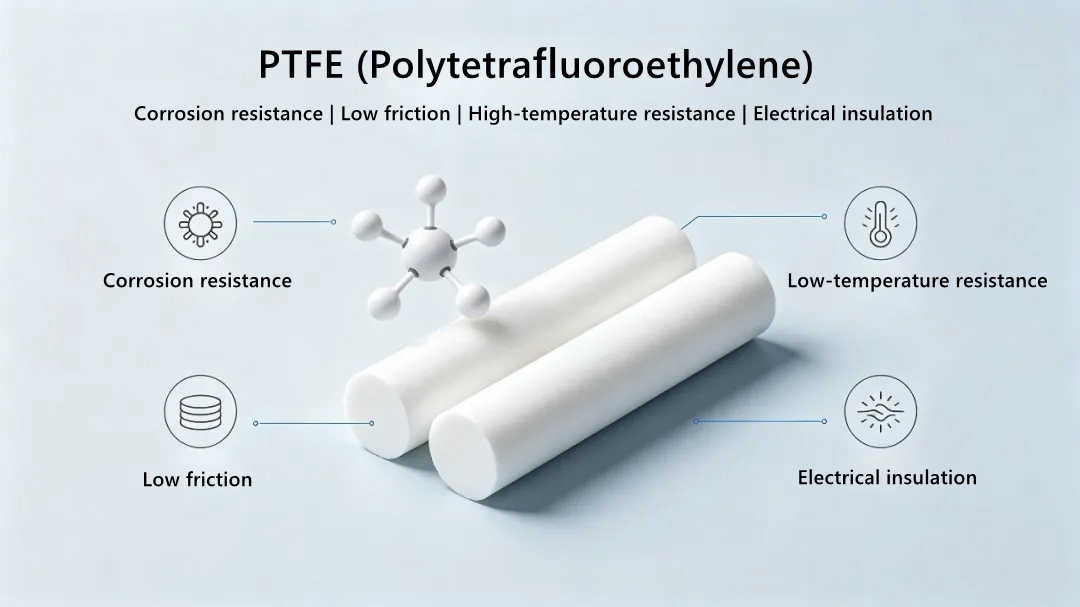
Polytetrafluoroethylene, abbreviated as PTFE, is a high-molecular-weight fluoroplastic. Due to its stable molecular structure and extremely low surface energy, it possesses many unique properties:
• Exceptional resistance to chemical corrosion
• Excellent resistance to both high and low temperatures
• Low coefficient of friction and good self-lubricating properties
• Non-absorbent and highly weather-resistant
• Stable electrical insulation performance
• Non-stick surface that is easy to clean
These properties make PTFE ideally suited for the manufacture of products such as seals, gaskets, bearings, valve seats, guide rails, insulation components, and corrosion-resistant linings.
II. Why modify PTFE?
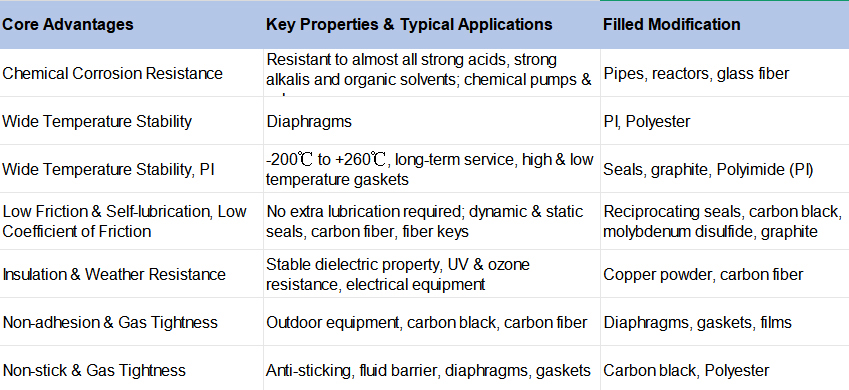
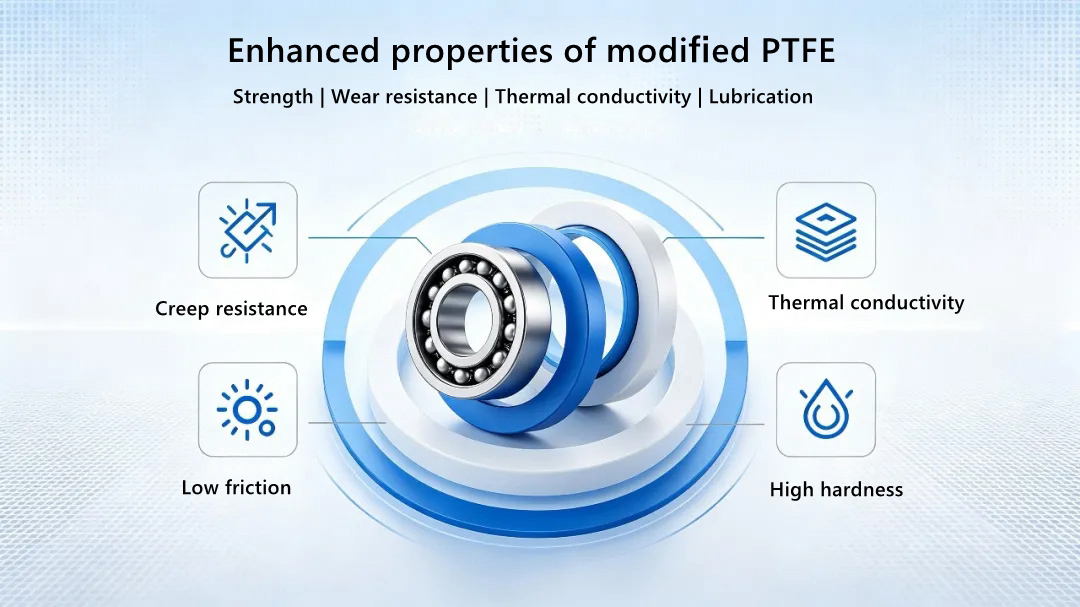
Pure PTFE still faces performance limitations under certain extreme operating conditions. For instance, in environments involving high loads, high-speed friction, continuous high-temperature operation, or strong corrosion, the material requires superior wear resistance, rigidity, thermal conductivity, and creep resistance.
By adding various filler materials, the properties of PTFE can be improved in a targeted manner:
III. Glass Fiber-Reinforced PTFE: Enhancing Strength and Stability
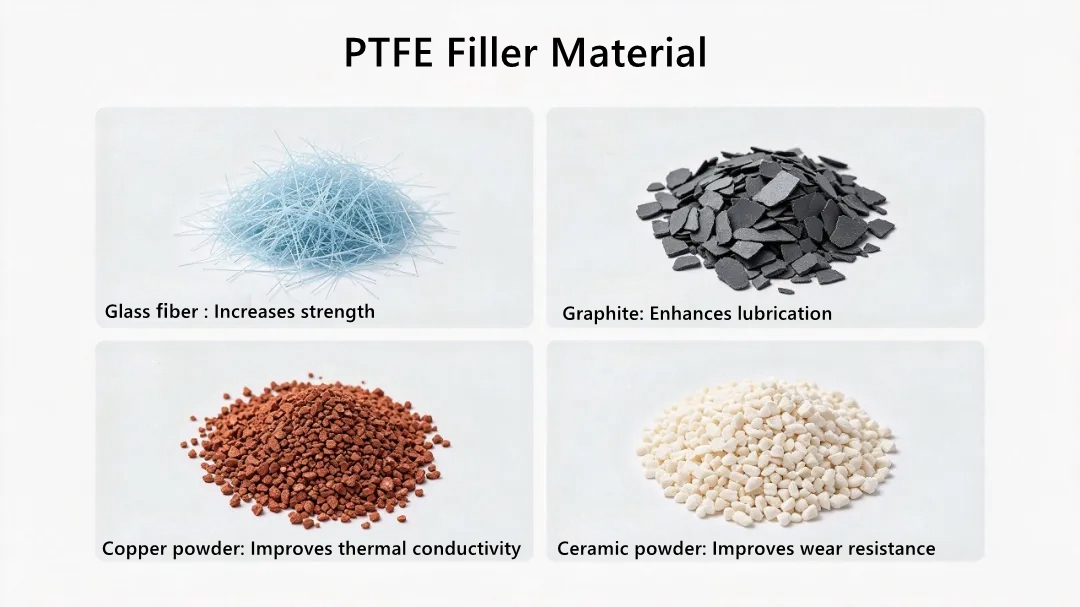
Glass fiber is a common reinforcing material used to modify PTFE. The addition of glass fiber enhances the material's tensile strength, compressive strength, and dimensional stability, while also significantly improving its creep resistance.
This type of modified PTFE is generally suitable for applications requiring resistance to a certain level of pressure and long-term stable operation, such as gaskets, valve seats, bearing bushings, and mechanical sliding components.
Ⅳ. Graphite modified PTFE: Enhanced self-lubricating and wear-resistant properties
Graphite has a good layered lubrication structure. After adding PTFE, it can further reduce the friction coefficient and improve the wear resistance of the material under continuous sliding conditions.
Graphite modified PTFE is particularly suitable for friction parts such as bearings, sliders, guide rings, and piston rings. In oil-free lubrication, low speed and high load or reciprocating motion scenarios, graphite-filled PTFE can show more stable tribological properties.
V. Copper Powder-Modified PTFE: Enhancing Thermal and Electrical Conductivity
Pure PTFE has poor thermal conductivity, whereas copper powder possesses excellent thermal and electrical conductivity. Incorporating copper powder improves the material's thermal conduction efficiency and reduces the risk of localized heat accumulation.
Copper powder-modified PTFE is commonly used in applications requiring a balance of corrosion resistance, frictional performance, and thermal conductivity—such as specialized bearings, electronic insulation components, conductive seals, and parts operating under high-temperature conditions.
Ⅵ. Ceramic Powder-Modified PTFE: Enhanced Hardness and High-Temperature Resistance
Ceramic powder is characterized by high hardness, superior wear resistance, and excellent high-temperature performance. Incorporating ceramic powder into a PTFE matrix significantly enhances the material's resistance to wear and abrasion, making it better suited for applications involving high speeds, heavy loads, and highly abrasive environments.
Such modified PTFE materials are commonly used in valve seals, pump components, bearing friction pairs, and high-temperature, corrosion-resistant structural parts.
VII. Selection Strategy for Modified PTFE
The choice of different filler materials is not merely a matter of simple substitution; rather, selections are made by combining materials based on specific operating conditions. For example:
• For high strength and dimensional stability: Glass fiber-filled PTFE is a preferred option.
• For low friction and self-lubricating properties: Graphite-filled PTFE can be selected.
• For thermal or electrical conductivity: Copper powder-filled PTFE may be considered.
• For high wear resistance and high-temperature tolerance: Ceramic powder-filled PTFE is a suitable choice.
• For complex operating conditions: Synergistic modification using multiple fillers may also be employed.
VIII. Conclusion
Polytetrafluoroethylene (PTFE) inherently possesses excellent properties regarding corrosion resistance, wear resistance, electrical insulation, and lubrication; modification technologies further expand the boundaries of its application. Through the strategic incorporation of materials such as glass fiber, graphite, copper powder, and ceramic powder, PTFE-based materials can be better adapted to the complex operating conditions found across various industries.
Jiangxi Zhaohui Fluoroplastic Products Co., Ltd. possesses extensive experience in the field of PTFE products and modified fluoroplastic materials, offering material selection, product processing, and customized solutions tailored to specific customer needs.
Jiangxi Zhaohui Fluoroplastic Products Co., Ltd.
Add: Changsheng Road, Shuidong Industrial Park, Ningdu County, Ganzhou City, Jiangxi Province, China 342800.